|
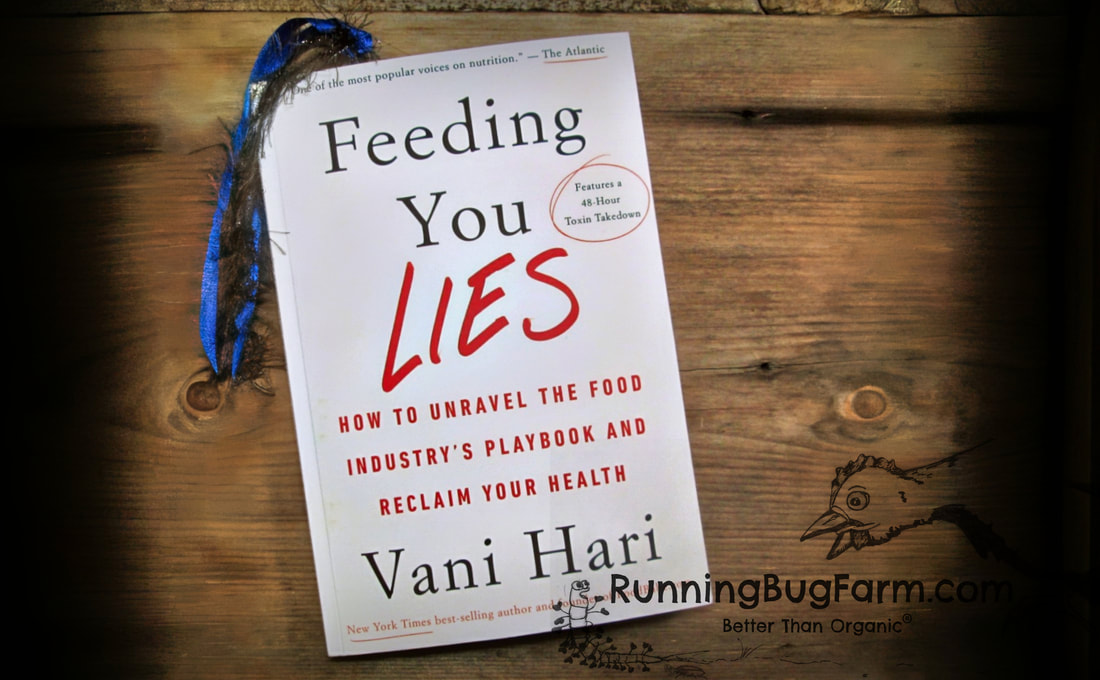
Feeding You Lies: How To Unravel The food Industry's Playbook And Reclaim Your Health by Vani Hari
Vani manages what I feel like I never could, she knows how to hook people & get them to listen to her regarding what is going on with our corrupt food system. While I'm older than her, her story feels very similar to my own (& I imagine many others). My disgust led me to organic food, fighting for the Certified Organic label, growing my own & eventually quitting my job & moving to where I am now so I could run my own farm organically full time. That is how disgusted I was/am with our food system. Fast forward two decades & folks are so much more aware (although still not enough folks) of the corruption in our food system. When GMO's became much more widely recognized, I was thrilled. I remember saying to my husband that now organic would finally reach it's full potential. Instead, folks grew angry over a lack of GM labeling & starting focusing on buying Non GMO food rather than supporting certified organic which is non GMO & so much more. It was & has been so disappointing for the organic movement. I love how Vani points out that organic is leaps & bounds better than non GMO & even points out that foods that are non GMO can & still do contain glyphosate. This is something I've been trying to teach folks for years. This misinformation is intentional to create as much confusion as possible regarding non GMO, organic, & conventional. The more confused folks are, the more likely they are to throw up their hands & give up. While I've been shouting to the roof tops for the past 20 years about our food system, nearly everyone looks at me like I'm crazy (thankfully less so now, then when I first started preaching). So, I may not be able to convince you, but maybe Vani can. Or maybe like me you are already a Food Babe follower & believer. If so, this book is worth gifting to someone who needs a little push in the right direction. You never know, it might finally click with them & we will have yet another educated consumer on our side. For me, this book is a nice refresher for what I've already known. I am hoping it will help me educate others regarding our food system. Unlike other books of this type, Vani keeps it very conversational. She never bogs the reader down with more information than they can handle. Everything is clear & easy to understand. She also backs up her statements, providing pages of End Notes that list her sources. Lastly, while Vani has her own line of food products (Truvia) she mentions it in the book but doesn't push her products. The mention simply goes with her story regarding our food system. She even has a 48 hour detox plan which simply suggests eating very healthy organic foods. No special foods from her Truvani line. When I consider how many authors use opportunities like this to self promote their supplements/products, the fact that Vani didn't do this is highly commendable. I greatly appreciate the lack of a sales pitch. This book is pure, real information. What you do with it is up to you. I wish you good health.
0 Comments
Nearly ten years ago, I grew my first Karina peas from certified organic seed & have never looked back. Karina Peas are an annual frost hardy plant that requires full sun in the spring & some shade towards summer (if possible). They are a sweet dwarf garden shelling pea with straight pods that are about 3" long. The pods are filled with approximately 6 to 8 medium to large peas. They can, dry, & freeze well. The plants are prolific easy growers with short growing vines of approximately 24-30". I find that staking 3-4' high wire fencing is more than adequate for the vines to climb on. Because they are a dwarf pea, some folks don't stake them, but I find them much easier to maintain, weed & harvest when the vines are given something to grow on. If you choose to stake them, put up the trellis or fencing wire before you plant. This way you are much less likely to disturb the young plants. Because the plants have shallow roots, they must be hand weeded around the base of the plants to avoid uprooting &/or damaging the vines. Using weed barrier cloth can help suppress weeds & keep cats from using your garden as a litter box. If you don't want to use weed barrier cloth, a weed hoe is a quick way to keep weeds from getting the upper hand. Don't use a weed hoe near the plants stems or you risk killing the plants by disturbing the roots or actually cutting the vine at the base. It's much easier to do than you'd think. Growing Guide Temperature for Germination: 45-60F Direct Sow: As soon as the soil can be worked Size: 24-30" Hardiness: Hardy Annual Hardiness Zone: 2-11 Sun: Full Water: Moderate Seed Spacing: 2” Seed Planting Depth: 1-2" Row Spacing: 1-1.5" Plant Spacing: 2" Days to Germination: 7-14 Mature: 50 days Direct Sowing: In the fall, generously add compost or other organic matter to the soil where you plan to grow the peas. If possible mix wood ash into the soil prior to planting in the spring. In early spring (4-6 weeks before the last spring frost or St. Patrick's Day), sow seed in well drained soil with a pH of 6.0 - 7.5. Sow no deeper than 2 - 4 times the seed diameter. If you want to speed up germination, soak the seeds in a bowl of water overnight. Do not sow in waterlogged soil. If spring in your area tends to be long & wet, plant in raised beds. Harvest in approximately 50 days. Seeds sprout in 7-14 days. Sow again in late summer for a fall crop. Note: Fall crops tend to be less prolific than spring crops. Harvest: In the morning after the dew has dried, carefully cut or pick ripe pods from the vine. Hold the vine securely with one hand so that you do not tug out the plant. Harvesting plump green pods will encourage the plant to produce more pods. Seed Savers: Isolate varieties by 1/8 mile for home use, or 1/4 to 1/2 mile or greater for pure seed. Allow the largest pods to dry naturally on the vine. When they are fully dry, clip the pods off of the vines. Remove the husks & save the largest of the dried peas. You can save the smaller peas for home consumption, feed them to your chickens, or toss them in your compost. Store the dried seed peas in a airtight container in a dark, dry, cool location. You can also store them in the freezer. Seeds should stay viable for about 3-4 years. Weeds & Water: Weed barrier fabric helps to both suppress weeds & keep more moisture in the soil where the plants need it. I have tried a wide range of weed barrier fabrics from free to more expensive & have found this 12 year fabric by Dewitt performs the best. |
Affiliate DisclosureThis page may contain affiliate links. If you choose to make a purchase after clicking an affiliated link, I may receive a commission at no additional cost to you.
As always, thank you so much for your support. I couldn't do what I do without you! Categories
All
Archives
February 2025
Hi there! My name is Jen. I'm a "tree hugging dirt worshiper" who has been organically farming for nearly two decades. It never ceases to amaze me at how much I've learned & how much I am still learning. I have studied natural health, nutrition, & herbs for nearly three decades. Our health & the natural world around us are connected in ways we don't often realize. How we treat the land & animals directly affects us in both body & mind. My goal is to provide others with truly natural humane goods from my own little piece of paradise, & to freely pass along whatever knowledge I pick up along the way. I am grateful every day to be able to have such a worthwhile & fulfilling job surrounded by the beauty & unpredictability of Mother Nature.
Copyright
You're welcome to link to Running Bug Farm or use a single image with a brief description to link back to any post. Republishing posts in their entirety is prohibited. |
RSS Feed