RUNNING BUG FARM
  • Shop
  • Reviews
  • Blog
  • About
  • Resources & Support
  • Angora Rabbit Colors

Beginner's Guide To Preserving

5/28/2021

 
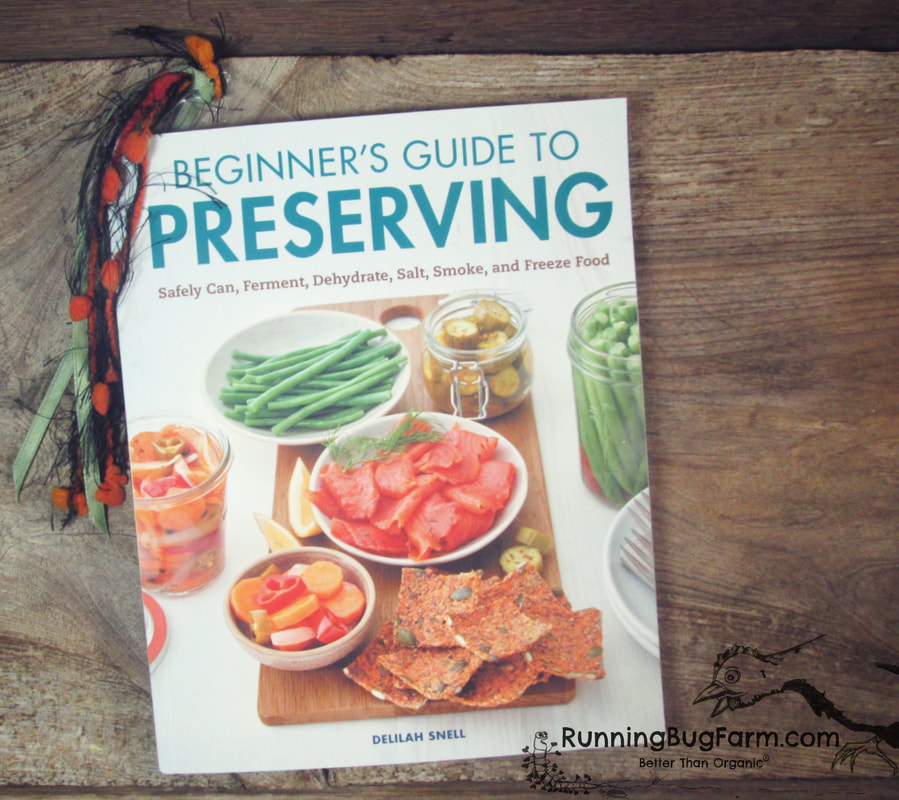
Beginner's Guide To Preserving: Safely Can, Ferment, Dehydrate, Salt, Smoke, and Freeze Food. A full time Eco farm woman's review.
Nice Primer If You Aren't Sure Of Where To Start
The Beginners Guide To Preserving: Safely Can, Ferment, Dehydrate, Salt, Smoke, and Freeze Food by Delilah Snell

If you really are a beginner at preserving I strongly recommend picking up a copy of The Ball Blue Book. It is updated often. When I first became interested in putting up food I read many books. Out of all of them, I use my Ball Blue Book nearly 100% of the time.

What this book has that the Ball Blue Book does not, is guidance on salting & smoking food. It even mentions kombucha which is awesome. I think kombucha is one of the best tasting & easiest to make fermented beverages you can drink. I've been making my own for close to two decades. There is a recipe for salted egg yolks that I made using smoked sea salt. After trying this, I decided the best way I like to preserve my eggs is by pickling them. Now that I'm older, I tend to consume more salt, but even this was much too salty for me.

Even though I have nearly two decades of experience putting up my own food, I rarely pass up books like this, even geared towards beginners. The reason why is that no matter how much I learn, I almost always learn something new. Also, because I have actual experience, I am also more likely to catch when authors make mistakes in their books. I hate for a beginner to be mislead. The only "mistake" I can report in this book is that the author is a tad too anal for me in her insistence that you must use Diamond Crystal Kosher salt. I understand her reasoning, but really, any non iodized salt will do. Really. It's fine. If it wasn't I would have died a long time ago.

The author is very clear about the importance of following the directions & not tweaking a recipe to how you think it should be. It is very important for food safety that you follow a recipe exactly. The only possible issue is if a recipe is incorrect, so let's hope that is not the case with this book as it is with the USDA's canning book! Yea, don't get that book! By the way, the author is a Master Food Preserver so odds are this book will steer all of us true.

I feel it is very important to point out that there are not many recipes in this book. There are also very few pictures. If you prefer a lot of photos in your books, you may not be happy with this. This book is more instructional on each preservation method with a handful of recipes tossed in. In each section the author provides guidelines for foods. If you plan to dehydrate say peas, find peas in the chart & see what is recommend to properly dry them. I plan to keep the book for now as there are a few other recipes I plan to try, but for the most part, there really isn't anything new here for me. However, the charts are rather handy for quick reference.

If you for example, are really itching to ferment more than any other method, then please, get a book on fermentation. Wild Fermentation by Sandor Katz is a great start. The same applies to dehydration. Whatever it is that floats your boat, get a book specifically about that method. That doesn't necessarily mean you shouldn't get this book. If you are curious about preservation in general & want to get your toes wet, this book is a great start. It thoroughly covers all the safety issues & equipment you'll need for each method. The only thing I found lacking was in the smoking section which only listed equipment & made no mention of a smoke house. If smoking is your thing, getting a book on that topic is what you want. See where I'm going with this?

This book has a sparkling wine jelly, a cranberry & wine jam recipe, the egg yolks I already mentioned, & a few other things (I can't think of them all off the top of my head) I'd like to see how they turn out. Note in the strawberry jam recipe & variations in this book, there is no mention of adding pure organic vanilla bean (not the pod, but what you scrape out from the pod). Oh my goodness, adding a little 100% vanilla bean to strawberry jam is out of this world.

In summary, if you are interested in preserving food but don't know where to start, or what may work for you, this book is a great primer. If you already know what method/s you want to use to preserve your food, pick up books on that specific method & maybe check this book out at the library to see if it's worth getting.

I wish you a bountiful pantry!

The Modern Homestead Garden: Growing Self-Sufficiency In Any Size Backyard

5/27/2021

 
The Modern Homestead Garden: Growing Self-Sufficiency In Any Size Backyard. An Eco farm woman's review.
Excellent Book For The Beginner Homestead Gardener
The Modern Homestead Garden: Growing Self-Sufficiency In Any Size Backyard by Gary Pilarchik

This is a very approachable book that is geared more towards beginners than those who are already experienced in food gardening. The author stresses the importance of just getting started. There is no reason to over complicate the process. You can learn as you go. I find this very refreshing. Nothing is ridged & the reader is encouraged to work with what they have & of course, grow what is of interest to them.

It is clear that the author has a very small homestead garden. This enforces the fact that one doesn't have to have acres of land in order to feed oneself. The importance of reducing ones dependence on outside sources cannot be stressed enough. To be fair no homestead is an island & you will likely always need to bring in outside sources. However, the idea is to reduce this dependency as much as possible.

Being a full time Eco farmer with acreage, I can tell you right now, that I only grow foodstuffs on a very small portion of my land. The rest is in hay or what I call pasture which is mainly for my cattle, although my birds & bunnies get a lot of enjoyment out of it as well. Growing your own food can be an incredible amount of work. This takes me back to the beginning. Start small & learn. It doesn't matter if you are growing one tomato plant on your apartment balcony, starting 5 raised beds, square foot gardening, or dreaming of something bigger. Just start small & grow from there.

This book solely focuses on the authors experience in his own homestead garden. This is important to note because everyone has different climates, therefore different growing needs. This doesn't mean the information presented is not of value, it is.

Vegetables discussed are the following:

Peppers
Squash & Zucchini
Cucumbers
Beans
Peas
Cauliflower & Broccoli
Kale & Collard Greens
Cabbages
Radishes
Asparagus
Onions
Lettuces

After exploring these vegetables in some detail the author discusses buying seeds (I have a minor disagreement here), seed starting, & transplants. My minor disagreement is that the author feels it doesn't matter if you buy conventional or organic seeds as you cannot buy GMO seeds. While it is true that you have to be under contract to grow GMO seed plants & that it is highly unlikely any seed you order or buy at the store for home use will be genetically modified, that is still no reason not to buy organic seed. My reason is that you are supporting a growing method that is kinder to the environment & the workers. As with everything else you buy, when you buy organic seed, you send a clear message to businesses that this is what you want. Nothing speaks louder than how we chose to spend our money. I also think it's important to support heritage seed suppliers as we are loosing more of our plant diversity. To me, conventional seed should only be purchased when all other resources have been exhausted.

One of the things I really like about this book is how the author stresses the importance of compost. Basically, if you always add compost, you'll likely never need to feed your garden anything else. Thankfully the author leans towards organic options should you find you need to buy soil amendments aka fertilizer. However, the author does give the green light on using conventional fertilizers on occasion if needed. I have been organically growing my own crops for nearly two decades & I have never, not once resorted to conventional methods to feed my crops. In fact, the only fertilizer I use consistently is OMRI approved to make the soil more acidic for my acid loving plants like blueberries, evergreen trees & strawberries. The author truly is dead to rights that if you consistently add plenty of compost to your beds at a minimum of once a year, you should never need to add anything to your soil to keep your garden healthy.

Chapter Five 'Building Earth And Raised Beds'. This is a short chapter but still useful. Here the author shows several ways you can create raised beds & sunken containers. He also discuses how to use soil amendments such as peat moss, coco coir, organic fertilizers, compost & manures.

Chapter Six 'Homestead Container Gardening'. This is great for those of you wanting to start small. In the beginning I did a lot of container gardening. It absolutely has it's pro's & con's as the author explains. Personally, I am not a big fan of container gardening, but that doesn't mean it can't be incredibly useful depending on ones growing situation. You even get to learn how to make your own container soil rather than buying a premix bags which can get expensive very fast.

Chapter Seven 'Tending Your Gardens'. This is all about maintaining healthy soils (hint: compost), watering, crop support, pruning, etc.

Chapter Eight is the dreaded chapter about pests, diseases, & the power of pollinators. The author keeps this pretty simple. He explains what he has found works best for him in dealing with various pests. The recipes provided are for natural methods like diluted soap, essential oils, baking soda, sulfur, & neem. The author also explains the importance of growing crops such as flowers that will attract beneficial insects to your garden. This is a method I have always employed. My crops share space with a wide variety of flowering plants which means I see an abundance of bees, butterflies, ground wasps & more. The author also mentions attracting birds. This is an iffy one as the birds can also become the pests, eating your crops.

Chapter Nine discusses growing fruit crops. What the author calls an edible landscape. The following are discussed:

Strawberries
Mulberries
Goji Berries
Blueberries (my favorite)
Raspberries
Blackberries
Grapes (something I want to grow)
Fruit & Nut Trees

In chapter ten you finally get to store & eat your harvest. Very basic pickling, canning, drying & freezing is discussed with a small handful of recipes. I highly recommend The Ball Blue Book mainly for canning guidance although it does cover other food preservation methods & Wild Fermentation if you are interesting in fermenting your foodstuffs.

Throughout the book there are plenty of charts & photos to both inspire you & help you along. While I am well beyond being a beginner, I enjoyed this book very much & consider it a keeper. I plan on trying a few of the pest treatment methods as I do have my own. However, I'm curious to see if some of the authors methods are more successful for me.

A Woman's Garden: Grow Beautiful Plants and Make Useful Things

5/27/2021

 
A Woman's Garden: Grow Beautiful Plants and Make Useful Things. Plants and project for home, health, beauty, healing, and more. An Eco farm woman's review.
My Favorite Farm Book So Far This Year
A Woman's Garden: Grow Beautiful Plants and Make Useful Things by Tanya Anderson

This turned out to be a delightful book.

Eight different woman owned farms are featured. Each farm has it's own specialty. Each farm is then followed with a project inline with the theme of the farm. The projects are beautiful & very useful. I also find the book to be incredibly inspirational. It is rare that I come across a book of this nature that I find so relatable & useful!

Chapter one is the kitchen garden. It features a farm in California. The book shows the basics of how to get your own Eco friendly garden started. The project is a pallet strawberry planter. Aside from growing plenty of crops, I too grow strawberries. I find them a royal pain in the butt thanks to their constant runners & the endless battle with weeds. This planter idea helps one deal with the weeds & makes harvesting easier. Note that it's not big enough for producing massive amounts of strawberries, but it is still worth trying. It appears to be a huge time & back saver.

Next is a garden in the UK (Devon). This farm is mainly focused on edible flowers which is always a lot of fun & beautiful to boot!  A list of popular edible flowers is provided along with when they bloom & what temperature they are hardy to. As with the previous section, plenty of inspirational photos & ideas are provided to enjoy your own edible flower garden. The projects are an edible flower planter (the planter isn't edible, the contents are), floral ice cubes, edible flower frittata, & lavender shortbread.

A garden in the UK (London) that focuses on herbs is featured next. As with the other farmers, this section provides a little background information on the farmer herself. A photo gallery of culinary herbs is provided followed by explaining how to grow culinary herbs. A chart is provided for classic Mediterranean culinary herbs, varieties to try, plant spacing & hardiness. Projects include a DIY Herb Spiral which lets you create a mini microclimate where you will plant various herbs in the spiral based on the herbs needs. How to create your own herb infused oils, growing & enjoying your own three mint Mojito, & herb embedded pasta, with you guessed it, your own, made from scratch, pasta.

Plants for skin care. This farm is based in the UK (Isle of Man). This farmer mainly grows  plants for their known skin benefits. How to grow plants for skin care is provided, plus a photo gallery & a chart on skin care plants & their uses. Projects include how to create botanical extracts, rose petal facial mist, herbal bath fizzies, & how to make your own lavender & alkanet soap. Hint: Once you make your own soap, you'll never want to buy the mass produced stuff in the store again.

Learn herbal medicine basics from a farm in Germany (Hamburg). This section provides relevant information regarding herbal medicine in the same vein as it does for the other cops/plants grown in the previous sections. Projects include growing chamomile for tea (& how to brew & enjoy it), chamomile tincture, calendula skin salve & lemon balm cold sore balm. I also make my own teas, tinctures, salves & balms. These are incredibly useful & I feel it is more important than ever to learn how to do these things ourselves & not be so dependent on outside sources as the most recent pandemic has shown us how quickly our supply chain can be disrupted.

Finally, back in the USA is a farm in North Carolina who focuses on herbs for the home. For example, preserves, home cleaners & skin care. As with the other farms the photos are gorgeous & inspirational. Guidance on how to grow your own home garden is provided with a basic chart & a cute example of drying your linens on blooming lavender & how you can bring sweet pea flowers into the home for a intense perfumed bouquet. Another chart lists plants with home uses, the plants growing preferences, etc. Projects include how to make your own raised garden bed, DIY rosemary & citrus kitchen spray (hint: this is so easy to make!), natural wood furniture polish, & soapwort multipurpose cleaner.

While I love every single farm (really, I do), Teresinha's garden in the UK (Birmingham) is one of my favorites because it's all about using natural dye plants. *Note: there is a small amount of misinformation in this section. Here you will learn the basics of how to grow your own dye garden. The main focus is on using these homegrown dyes on fibers. However, there is a fun example of how  certain plants can be used to dye foodstuffs. This is not only great for adults but also a great project to try with kids. How to use dye plants, a chart of the common dye plants & the colors you can expect to get from them is provided. Projects include preparing the fibers for dyeing, dying yarn with onion skins (the colors will amaze you) & naturally coloring handmade soap (as a soap maker, I can tell you this is a lot of fun). *The minor errors in the section are in listing the colors of animal fibers, stating they come in only white, grey, brown, & black. For some reason shades of red was left out. Not brick red or fire engine red, but more of a soft orangy fawn or buff color. Angora rabbits & angora goats can & do produce coats known as red along with the colors already mentioned. The other minor error is in listing that cotton only comes in creams & white. As a grower of organic heirloom cotton plants I want you to know that cotton comes in green as well. There are several shades of green depending on the type of cotton plant. There is also a rich brown that one would hardly refer to as cream.

The last garden is in Canada (Ontario). It features fun ways to upcycle & recycle goods giving them a new purpose in the garden, including making your own fall leaf garland. A photo gallery of creative garden ideas is provided. Some are more eco friendly than others. Some repurpose while others use nature; a woven unpainted basket. Guidance on how to create your own creative & low cost garden. Lists of plants you can propagate from cuttings & from divisions are included (rather than having to buy which gets expensive fast), how to create compost & how to craft with plants. Learn how to make your own fossil stepping stones, pressed flower candles & paper mache leaf lanterns.

From the farms above, you can clearly see that the majority of them are based in the UK. As a US farmer I would have loved to see at least one farm featured that was at least in the Midwest. The United States is huge & we have so many different growing climates. Often a growing climate in the UK, will not be suitable for those of us in the US. Be sure to pay attention to the growing requirements provided to see what works for you. To be fair to the author, in the back of the book the author explains how she first wrote this book during the first months of the China virus outbreak. This limited her ability to travel. I sincerely hope she creates another book featuring another handful of women farmers in the future as I will be sure to get it.

Sustainable Gardening: Grow a "Greener" Low-Maintenance Landscape with Fewer Resources

5/23/2021

 
Sustainable Gardening: Grow a
There Are Much Better Books On The Subject
Sustainable Gardening: Grow a "Greener" Low-Maintenance Landscape with Fewer Resources by Vincent A. Simeone

I'm a full time Eco farmer with well over a decade of farming experience. I still love to read books on growing things, even beginner books as I almost always learn something or am refreshed on something I may have forgotten. Plus, these books are often inspirational & especially fun to read in the winter when the back breaking labors of spring through fall are but a memory.

The thing with this book is it's too basic. The author discusses sustainability, but I don't feel like he really digs in deep enough or provides enough ideas, examples, or projects to help someone along a greener path.

I was also disappointed in the short blurb about organic gardening. The author almost seems to have a bias against organic gardening. Mainly he insists that it's more expensive & that's it's biggest downfall. I'm really at a loss over this view point. I can't speak for others, but to me sustainability & organic go hand in hand. Yes, certified organic seeds are more expensive & using OMRI approved products when needed is also more expensive. But when you are being sustainable, you are supposed to be utilizing more of what you have right where you are. Plus, you don't use a bunch of toxic chemicals in organic. Matter of fact, all I use each year is my own compost to enrich my soils. Acid loving blueberry bushes get OMRI approved fertilizer. Young heirloom cotton plants may get some neem &/or peppermint oil to deter aphids & the ants who milk them. But that's it. How on earth is this expensive?

The meat of the book is various plants the author feels are worth growing in a sustainable environment. Many species are not native & some are considered invasive. I found it odd to not include things like blueberry bushes. They produce nice hedgerows, berries, & stunning fall foliage. Yet somehow they don't make the grade.

I feel it is also important to point out that the section with the various plants doesn't include what zone these plants are suitable for. Basically, if you think one of the plants mentioned in this book might work for you, you'll have to look into it further to make sure it works in your area. That seems to defeat the point of the book.

The last of the book mentions things like pests, water management, lawn free choices, composting & soil management. The only thing that I found useful to me was the permeable pavers. I'd love to have these to drive on, but they are way beyond affordable for me unfortunately. There were also a few photos that gave me some ideas for projects on my own farm. But for the most part, this book wasn't worth my time.

There are an endless amount of books available for living more sustainably that provide much better in depth & useful information than this book. With all of these options, I really don't think there is any need to bother with this particular book.

The First-Time Gardener: Growing Plants and Flowers

5/15/2021

 
The First-Time Gardener Growing Plants And Flowers. An Eco farm woman's review based on actual experiance growing food naturally.
The authors wrote this book with one main goal in mind; to get you to go to their website.
The First-Time Gardener: Growing Plants and Flowers: All the know-how you need to plant and tend outdoor areas using eco-friendly methods (The First-Time Gardener's Guides, 2) by Sean McManus & Allison McManus

The authors wrote this book with one main goal in mind; to get you to go to their website.

Initially I liked this book. I'm a full time eco farmer. I mainly grow food & fiber crops along with herbs & flowers. I recently read an excellent book on houseplants titled 'My house plant changed my life' by David Domoney. After reading that book, I was much more interested in reading about growing plants. Obviously I'm not a first time gardener, but for the most part I have found that no matter how much you learn, you know nothing. Okay, not really, but the point is, even a book for beginners can teach an old dog new tricks or simply refresh us on things we may have forgotten.

So the beginning of this book starts off pretty good providing the newbie with the most basic of basics. I was rather surprised by just how basic it went truly keeping in line with what a beginner needs to know. However as I continued to read I became more & more disenchanted with this book. It is incredibly rare for me to not like a book on growing things. Sure, some may have some issues I will point out but generally, I find them all worth reading until now.

If someone orders a book that is supposed to teach them, they shouldn't have to go to other sources for additional information especially if this is basic information that is needed to do things properly. I get the distinct vibe that the authors wrote this book with one main goal in mind; to get you to go to their website. I don't know about you, but when I sit down to read a book, I don't want to be told to visit a website for more information. I want to read that information in the pages of the book I have before me. If I wanted to look this stuff up online, I'd be online!

I guess I also should point out to those "privileged" folks who enjoy cheap high speed internet & cell service that there are those of us who still don't have access to the internet unless we opt. for very expensive & very slow satellite. What about cellular? "Can you here me now?" Sometimes yes, sometimes no. Fingers & toes crossed that Elon Musk's Starlink will save us rural folks. This is the Great Rural Divide. It is more expensive for 10xs slower internet in rural areas than it is in NYC. We rural folks buy books & make good use of them. For the love of equality, stop sending us to the internet to learn more! We bought your book, so give us the info. we need.

Stepping off the soap box...

Back to the beginning. As stated, this is the most basic of basics & no more. No more I tell you! Have a bug problem? The book tells you to find ways to treat for them & not to use toxic chemicals. I'm all for avoiding toxic chemicals, but um how do we deal with the bugs? Hello? Fungal problem? Same deal. Soil problem? You got it, same deal.

You get told certain plants have certain requirements. Some need full sun, some part shade, some full shade. Some require more water than others. Some can tolerate different climates better than others. Okay, which plants are good for these different climates & light levels? Hello? H-e-l-l-o??? I'm going to take a leap of faith here & guess that you can find out more at the authors website. Ho hum.

Do you have problems with the wildlife? The book tells you we all have to deal with wildlife. Put up some fencing or something. Try hot pepper spray. That's about as helpful as it gets. Sure, fencing can keep out deer, but not just any fencing. Sigh. Deer jump. Hot pepper spray washes off...

There is simply too much important information missing from this book. There is plenty of white space in the book. Too bad the authors didn't decide to fill it with something useful to the reader.

Sadly, this book is not a keeper. I regret ever ordering it.

    Affiliate Disclosure

    This page may contain affiliate links. If you choose to make a purchase after clicking an affiliated link, I may receive a commission at no additional cost to you.

    As always, thank you so much for your support. I couldn't do what I do without you!

    Categories

    All
    Angora Rabbit Care
    Book Corner
    Garden Growing Guide
    Homesteading: The Quest For A Simple Life
    Recipe Corner

    Archives

    February 2025
    January 2025
    August 2024
    April 2024
    February 2023
    August 2022
    June 2022
    May 2022
    March 2022
    January 2022
    June 2021
    May 2021
    April 2021
    February 2021
    January 2021
    December 2020
    November 2020
    October 2020
    September 2020
    August 2020
    May 2020
    April 2020
    March 2020
    February 2020
    January 2020
    December 2019
    November 2019
    October 2019
    September 2019
    July 2019
    June 2019
    April 2019
    March 2019
    February 2019
    January 2019
    November 2018
    September 2018
    August 2018
    July 2018
    March 2018
    January 2018
    December 2017
    October 2017
    September 2017
    May 2017
    April 2017
    March 2017
    February 2017
    November 2016
    October 2016
    June 2016
    May 2016
    April 2016
    March 2016
    February 2016
    January 2016
    May 2015
    March 2015
    December 2014
    November 2014
    August 2014
    March 2014
    February 2014
    December 2013
    November 2013
    August 2013
    April 2013
    February 2013
    January 2013
    December 2012
    October 2012
    April 2012
    October 2011
    September 2011
    June 2011
    January 2011
    June 2010
    May 2010
    April 2010
    March 2010
    December 2009
    November 2009
    November 2008
    March 2008

    RSS Feed

    Do you dream about living the simple life?  Your own idyllic farm where the cows moo and the veggies are the best you've ever eaten? I've got a surprise for you, homesteading isn't easy! Join me at my small eco family farm where we stumble often, and learn as we go. This is indeed the good life, but it is also a very hard life that only rewards for that hard work... or not!  Back to the land, it's tough and I love it.Hi there! My name is Jen. I'm a "tree hugging dirt worshiper" who has been organically farming for nearly two decades. It never ceases to amaze me at how much I've learned & how much I am still learning. I have studied natural health, nutrition, & herbs for nearly three decades. Our health & the natural world around us are connected in ways we don't often realize. How we treat the land & animals directly affects us in both body & mind. My goal is to provide others with truly natural humane goods from my own little piece of paradise, & to freely pass along whatever knowledge I pick up along the way. I am grateful every day to be able to have such a worthwhile & fulfilling job surrounded by the beauty & unpredictability of Mother Nature.

    Picture
    Picture

    Copyright

    You're welcome to link to Running Bug Farm or use a single image with a brief description to link back to any post. Republishing posts in their entirety is prohibited.

Running Bug Farm Disclaimer: Nothing contained in articles &/or content is or should be considered, or used as a substitute for, veterinary or medical advice, diagnosis or treatment.
Running Bug Farm, West Union, WV, USA 26456 | © 2008-2025 All Rights Reserved
RunningBugFarm.com
  • Shop
  • Reviews
  • Blog
  • About
  • Resources & Support
  • Angora Rabbit Colors