RUNNING BUG FARM
  • Shop
  • Reviews
  • Blog
  • About
  • Resources & Support
  • Angora Rabbit Colors

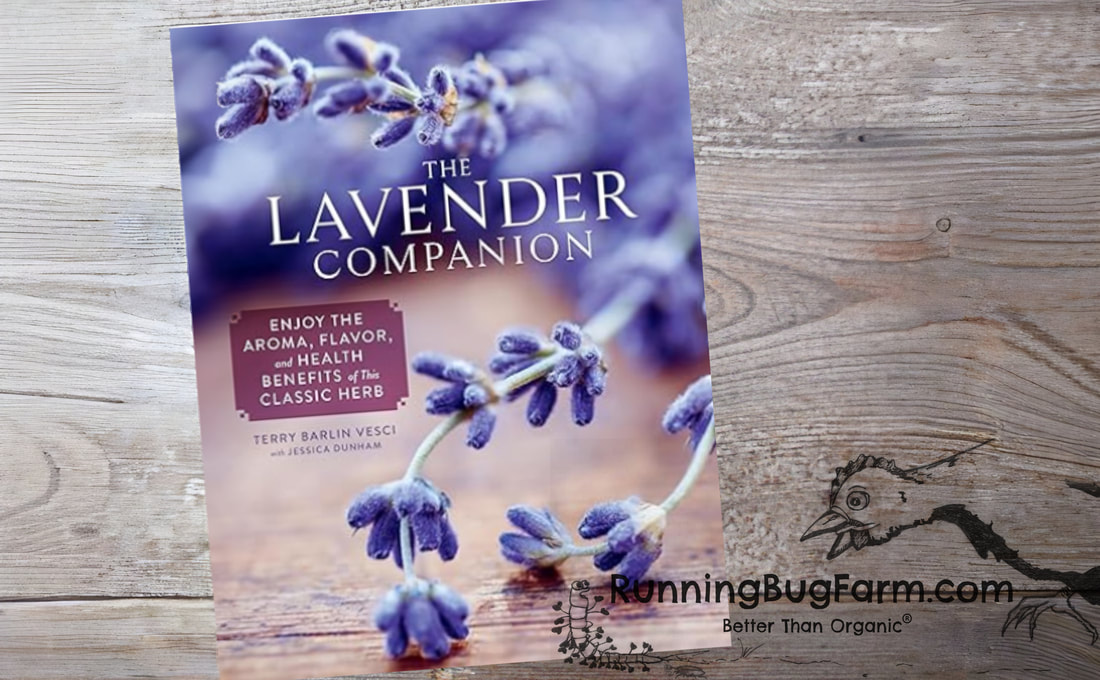
The Lavender Companion: Enjoy the Aroma, Flavor, and Health Benefits of This Classic Herb

4/13/2024

 
Picture
The Lavender Companion: Enjoy the Aroma, Flavor, and Health Benefits of This Classic Herb by Terry Barlin Vesci & Jessica Dunham

My first attempt at growing lavender was over a decade ago. I purchased a bunch of plants, put them in the ground, watered, and weeded them. They struggled to get off to a good start. To this day, I don't know why. They got a lot of sun and excellent drainage. After that failure, I moved on. Instead I focused on what I could grow. Frankly, those first attempts are pretty hazy in my memory.

Growing things where I'm at now, was still a huge learning curve at that time. I went from the rich, black, sandy soil of the NJ shore to the dense, red, clay soil of the WV mountains. I assumed lavender wasn't a good choice for my growing area. I was wrong.

As I gained experience in my growing climate and soil type. I decided I wanted to grow lavender again. This was a little more successful and I learned from observation. Plants did die. Some did not. Dampness matters. A lot. Not once did I read about how to grow lavender. I most certainly should have. This is my first book on the topic. Funny, because from about five years or so of experience at this point as a causal grower, I've learned the most important information that this book provides. Had I took the time out to read about growing lavender, I could have saved myself time and money by avoiding a lot of mistakes. Even so, I did learn from them. Personally, I feel that mistakes are fine. We all make them. If we learn from them, then it's a good thing. If on the other hand, we continue the same behavior that led to the mistake, well, I just have no words for that.

The lavender I grow in my area, USDA Plant Hardiness Zone 6b, is Munstead Lavender. It is a English lavender, Lavandula angustifolia. They are smaller plants more suited to cold weather. They are also good for culinary and fragrance. Some of my plants still do not survive the winter. I am still learning. The second location I chose for my plants wasn't the best choice. It doesn't drain as good as other areas. It's not swampy, not even close. But when it rains a lot or we get several days of rain, it simply doesn't drain as good as other areas. Because I have several plants established there, I've left them there. When I aquire new plants, I plant them in dryer, better draining areas with soil that isn't as rich.

What I like best about The Lavender Companion is the stunning photography and the inspirational story behind Pine Creek Lavender Farm. I was under the impression that the beautiful photos were all taken at Pine Creek Lavender Farm. And that the photos were of their own lavender and farm. At the end of the book I was disappointed to read that another lavender farm provided photos. I'm not sure how many or which. Now knowing this, I would like to see small text with each photo crediting where it came from. The authors created such a wonderful vibe with the story behind their successful farm based business. Properly identifying the photos helps paint a more accurate picture of Pine Creek Lavender Farm.

The Lavender Companion starts off with some very interesting history on lavender and it's uses. It also lists several varieties of lavender with photos. The book mainly focuses on the three types of lavender grown on Pine Creek Lavender Farm. I knew there were different varieties of lavender. However, I never knew there were so many varieties or that lavender can come in other colors. This is yet another example of, no matter how much one knows, there's always more to learn.

The introduction implies that this is mainly a cookbook. Heck, they indicate that they offer a lavender cooking and baking school! While this does have recipes (I list all of them later in my review), it's not a cookbook in the way one would expect. If I'm buying a lavender cookbook, I expect a lot of recipes with lavender. While this does contain a nice little handful of various recipes, the quantity simply does not meet expectations the introduction created. If you are looking for a lavender cookbook and that's it, you may not be happy. Please take a peek at the recipes I have listed to see what you think.

My hopes in acquiring this book was to both learn more about the lavender that I grow and to find additional creative ways to put it to use. Cooking with lavender was the lowest of priorities. Considering that I haven't found lavender teas to my liking, I figure I wont like it in cooking either. For me, it seems like drinking perfume. However, I know folks who simply love lavender in their drinks and foods. Because it's been over a decade since trying lavender in anything I consume, I am going to give it another go after reading this book.

For the cooking section, the type of lavender that works best for the recipe is provided. If you don't have or grow several varieties of lavender, as long as it's a culinary lavender, it should work. Obviously if you do have the lavender called for in the recipe, all the better.

In The Kitchen:
  1. Lavender Himalyan Salt (buds)
  2. Lavender Herbs de Provence (buds)
  3. Lavender Lemon Pepper (buds)
  4. Peppender (buds)
  5. Lavender Sugar (buds)
  6. Lavender Simple Syrup (buds)
  7. Lavender Honey (buds)
  8. Lavender Vinegar and Oils (buds, sprigs are optional)
  9. Lavender Peach Jam (lavender sugar which is made with buds)
  10. Sticky Lavender Honey Chicken (lavender honey & salt both made with buds + 2 types of lavender buds)
  11. Lavender Pecan Salmon (lavender honey & salt both made with buds + buds)
  12. Farm Favorite Jammy Pork Loin (lavender peach jam & salt both made with buds + buds)
  13. Tuscan Stew (lavender salt, peppender, lavender lemon pepper all made with buds + sprigs)
  14. Provence Farm-Style Tomato Soup (lavender herbs de provence which is made with buds)
  15. Vegetarian Curry (peppender & lavender salt both made with buds + buds)
  16. Watermelon Summer Salad (lavender sugar, honey, salt, & peppender all made with buds)
  17. Lavender Roasted Potatoes (lavender salt & lemon pepper both made with buds + buds)

As you can see, essential oils are not used. The cooking recipes all utilize actual lavender just like you would use herbs. Fresh out of the garden if you are lucky to be growing your own herbs.

In order to make many of the other recipes in this book, the first nine recipes should be made in advance. They are the pantry staples. I plan on working them into my cooking schedule over time. I'm most likely to make the Lavender Roasted Potatoes first (minus the pepper & with sweet potatoes as I avoid nightshades & seeds for my AIP lifestyle). Other recipes aside from the pantry basics, I may avoid or alter to fit my dietary requirements. For most folks though, this will not be an issue.

Baking With Lavender:
  1. Lavender Chocolate Cake (lavender sugar & salt both made with buds + sprigs)
  2. Lemon Lavender Sandwich Cookies (lavender sugar made with buds + buds)
  3. Lavender Cinnamon Rolls (lavender honey & sugar both made with buds)
  4. Lavender Lemon Italian Morning Cake (lavender sugar made with buds)
  5. Fall Spice Lavender-Pumpkin Bread (lavender sugar & salt both made with buds)
  6. Lavender Ice Cream (lavender sugar made with buds)
  7. Lavender and Olive Focaccia Bread (lavender sugar, salt, & lemon pepper all made with buds + buds & leaves)

I'm not a big ice cream eater. I don't consume dairy because I cannot tolerate it. I do like to make ice cream with coconut milk. It might not sound good, but it is amazing! I sometimes will make a batch of rum raisin coconut milk ice cream or regular vanilla coconut milk ice cream. I am thinking about making a batch of vanilla & adding a little lavender to a serving to see if I like it before committing an entire batch.

Lavender Mixology:
  1. All Natural Lavender Margarita (lavender simple syrup & salt or sugar all made with buds + sprigs)
  2. Lavender Alligator (buds & sprigs)
  3. Lavender Lattes & Cocoas (lavender simple syrup made with buds)
  4. Lavender Mint Sun Tea (stalks & optional lavender honey or sugar both made with buds)

Even though I mentioned that drinking lavender teas seems like drinking perfume to me, I am going to try the Lavender Cocoa and the Lavender Mint Sun Tea. I really hope I enjoy both. Hot Cocoa is my sweet tooth downfall. I'm not sure what I'll think of this. I'll be finding out soon. I do know that I love rose in my hot cocoa. I grow peppermint, spearmint, and chocolate mint on my Eco farm. If I like mint and lavender this is sure to be a refreshing summer beverage (minus the sweetener).

The Body Care recipes are pretty basic. They mostly use lavender essential oil which isn't what I was looking for because I don't make my own lavender essential oil.
  1. Sugar Scrub (essential oil)
  2. Wellness Soak (essential oil)
  3. Face Wash (essential oil)
  4. Face Oil (essential oil)
  5. Bath Bombs (essential oil & optional lavender buds)
  6. Bath & Massage Oil (essential oil & lavender sprigs)
  7. Beard Oil (essential oil)
  8. Aroma Ball (essential oil)
  9. Lavender Tea - I'm not sure why this is in this section. This may change once published - (lavender buds)
I'm considering making beard soap utilizing the essential oils in the Beard Oil body care recipe. I also like how the face oil recipe looks. I may consider that for future use. For face wash I find using a pure natural oil applied to my eye makeup, then gently rubbed to loosen followed by my own hand crafted goat milk soap to wash, works amazing. I've no need for facewashes. At this point in my life I think they are just as silly as body wash. But that's just me. I know plenty of ladies who swear by both and hate using "boring" old fashioned bar soap even if it is hand made and organic. The Wellness Soak is something I can only dream about because I don't have a home with a bathtub. However, this is something I can make as a foot soak!

In The Home: This features a really fun lavender braid. There are so many uses and possibilities for this. It's such a simple and useful project. Great for selling at the farmers market, gift giving, and for storing herbs in the kitchen for personal use. This recipe utilized lavender stalks.
  1. Lavender Braid (lavender stalks)
  2. Lavender Sachet Mix (buds)
  3. How to make your own sachets to hold the mix
  4. Hanging Sachet - how to make a sachet with a little hanging ribbon
  5. Eye Pillow
  6. Lavender Spa Mist (essential oil & hydrosol)
  7. Spray Cleaner (essential oil)

I'm highly likely to make the Lavender Braid. Being a Eco farm woman, I grow everything required to make this braid and to even make some of my own variations. I have already made my own versions of sachets which I love.

There is a chapter on growing lavender. It is surprisingly basic. Lavender isn't fussy. It doesn't have a lot of requirements. Mainly, don't over water it. If anything, once established, let it be a little dry. Too much moisture kills more than it helps. Pine Creek Lavender Farm is in Arizona. They seem to have a great climate for growing abundant amounts of different types of lavender. Even though the care is rather simple, I still learned a little. Had I not already made so many mistakes as mentioned earlier, I would have learned a lot more.

I love the harvesting and drying suggestions in this chapter. Naturally, I have my own methods that have worked wonderfully, but I also like how they recommend doing things as well. When I begin to harvest this year, I will be incorporating some of their recommendations into my routine.

I look forward to adding this informative book to my shelves, when it is published.

I received an advanced readers e-copy (ARC) of this book from Netgalley, Terry Barlin Vesci & Jessica Dunham and Storey Publishing for an honest review.

Nettle Power: Forage, Feast & Nourish Yourself with This Remarkable Healing Plant

4/11/2024

 
Is 'Nettle Power: Forage, Feast & Nourish Yourself with this Remarkable, Healing Plant' worth adding to your holistic library? I research the claims after reading this informative book from cover to cover and detail my results to help you decide.
If you can move past the woo woo feel of the author (unless that's your thing of course, then by all means, enjoy!), this book contains a nice amount of easy to read general information about nettles.
Nettle Power: Forage, Feast & Nourish Yourself with this Remarkable, Healing Plant by Brigitte Mars

Nettles. They grow on my little Eco farm. Mostly along stream banks in somewhat more shaded areas of my land. I've ignored them. Jewelweed grows too. That, I learned to appreciate as I tend to get poison plant - ivy, oak, etc. rashes rather often. Infusing oil with jewelweed is a bit of a pain. At some point, I'll have to write up an article for ya'll about it so you too can reap the benefits of this amazing plant without having to depend on outside sources to treat your skin.

Back to nettles. Why I've been ignoring them and not the other wild bounty on my land is something I really can't explain. Nettles never really caught my attention. In research on health and wellness, I rarely come across recommendations for consuming nettle or using it topically. Initially, before reading 'Nettle Power', I thought it was because nettles weren't the sort of plant for health, pet, &/or farming issues that I have found I needed help with. Now that I've read this book, I see that I'm wrong.

This left me perplexed. It also left me concerned about the book. Is this book valid? It is a bit more woo woo than I care for. While I was familiar with some uses for nettles, mainly nettle tea. Something I've drank, but don't care for the taste - at all. That was about it. Yet, it seems that if the author is to be believed and trusted, nettles are good for arthritis, allergies, the kidneys, men's prostate and women's reproductive health, and much more. Seems too good to be true. So I started to research nettles.

In a general internet search using DuckDuckGo (because I don't like my search results suppressed), I did find some health claims to be backed, but not with any gusto. More with caution. For example, I found numerous sources that claim that nettle root helped with men's prostate issues (this is important to me because my middle aged husband needs help in this area). Studies indicate that nettles do help. But they don't know why. In fact, they don't even help to shrink the prostate! But generally, the root seems to help with frequency of urination and volume. Is it a placebo effect? I'm not a scientist. I can't say. What do know, is that nettle root is one of the ingredients in the prostate supplement my husband has been taking for at least two years for prostate health.

What about female reproductive health? I have Endometriosis. I read about women's health in this area rather often. I'm constantly researching it and looking for the latest information. I don't recall ever reading about nettles for Endo or anything female related at all. Silly me. It seems that one can find nettles added to a wide variety of health products formulated for women's reproductive health. Especially fertility. While it's technically possible, I highly doubt I'll ever be fortunate enough to have children this far into my life. Even so, I came across some interesting products that seem like a great way to add some nettles to my diet organically and with other ingredients, seeing how I don't like the taste of pure nettle tea.

Wholesome Story offers a organic fertility tea  that any woman can appreciate with the following certified organic ingredients: cinnamon bark, spearmint leaf, nettle leaf, red raspberry leaf, chamomile blossom, and red clover blossom.

Pink Stork offers two teas that I plan on ordering. Full disclosure, I ordered the fertility tea by Wholesome Story, but haven't tasted it yet. When I do, I'll provide an update. If I like Wholesome Story's tea, I plan on trying these teas as well. I'm a dirt poor Eco farmer. I can't order whatever I want whenever I want. I have to budget myself. Just the facts of my world. Hint: growing my own foods organically is incredibly labor intensive and takes the majority of my time, but boy does it pay off! It's so fresh and bursting with nutrition. It's not from another country. I don't have to question it's quality or wonder about how the workers were treated.

Okay, Pink Stork.
USDA Certified Organic Woman's Fertility Tea contains organic peppermint, chaste tree berries, red raspberry, stinging nettle, passionflower, and lady’s mantle.
and
USDA Certified Organic Labor Prep Tea contains organic rosehip, stinging nettle, chamomile, oatstraw, and red raspberry leaf.

There are many other teas, supplements, etc. that contain nettles. I listed these three in particular because they are of interest to me. Don't let the names of the teas fool you. Just because a tea is called "Labor Prep" doesn't mean anyone can't benefit from it. Other blends I have come across contain ingredients that I don't like (licorice), or are in the nightshade family (
ashwagandha) and can cause inflammation in certain individuals. I follow an anti inflammatory diet for my Endometriosis.

Arthritis is mentioned often in this book. What is interesting, is that the author claims that deliberately stinging yourself with nettles in the affected areas will help treat ones arthritis symptoms. She even goes as far as to claim it cures arthritis. I'm not too sure how I feel about deliberately causing myself a painful itchy rash. But, if after doing this three or more times, arthritis is truly gone, then it seems like it would be worth it. However, the author also briefly mentions that her and her partner both enjoy swatting one another's privates with nettles prior to intercourse for intense coupling. This is one of those woo woo moments I'm just not feeling. If anyone decides or already does engage in this sort of behavior, feel free to comment. But please, keep it clean.

Making salves with nettles to treat arthritis, similar to making jewelweed salve for poison ivy, is another possible method without the pain. However, the author stresses that,

"...the nettle plants hollow sharp hairs act as needles when they penetrate the skin. Formic acid, acetylcholine, serotonin, and histamine held in the chamber at the base of the hairs squirts into the wound. These compounds irritate the skin and create an antihistamine reaction which ultimately clears out and reduces inflammation."

If this is the case, then it seems unlikely that a salve will actually work in treating arthritis. As previously mentioned, if you have tried either or both of these methods and have or have not had success, please let me know in the comments.

My point in mentioning some products and methods is that while I didn't find much in my basic internet search to back up the claims in this book, I instead found by accident, products that contain nettle that support the claims in this book. I wasn't searching for these products in particular. All I searched for was, "organic nettle". Also, how can a pharmaceutical company make big billions by suggesting we deliberately sting ourselves with nettles? You need live plants for this. As far as I know, it can't be bottled and patented - yet.

Unfortunately we are in a world where anything outside of mainstream medical treatment is shunned or even hidden. As is often said, there aren't billions in profits from natural remedies. Does this mean natural methods are the cure all? No. Not at all. Conventional methods have their purpose and save lives. The fine line is in understanding when you need a holistic or conventional method for what ails you. My motto is to first try natural methods. If after exhausting all possibilities, the ailment doesn't improve, it's time to try conventional methods. This doesn't mean the conventional method will work either. But you wont know until you try.

I like this book. It does need some editing though. The resources provided to back up the authors claims are mostly from the 1990's. I'd like to see newer sources and more sources that are not other authors books. I'd like to see some clinical studies and double blind tests. This would add more validity to the claims. As it stands now, the book comes across as a bit shady with questionable claims.

Including quotes from long dead philosophers, poets, herbalists, artists and like is not convincing to me. I'm not saying they are wrong, but I'm not saying they are right either. On the topic of those who have come long before us, the author also provides some historical information regarding nettles. The history she provides about nettles is enjoyable, but not necessarily factual.

I also would like to see more recipes for topical treatments.

The food recipes are mostly unusable to me as they tend to include ingredients I no longer consume in order to manage my Endometriosis. However, I understand that I'm the minority in this area and I believe that most folks will find a great many of these recipes highly enjoyable.

The author even provides basic guidance on using nettle as a dye plant. Being a natural grower and one who dyes natural fibers with plant based dyes, I'm more than pleased that this is included in her book.

If you've never made your own tincture, Brigitte Mars shows you just how easy it is. You have the option of using either an alcohol base or glycerine. Personally, I prefer to use organic glycerine as I find organic alcohol tinctures rather nasty, but I can choke them down. Glycerine is naturally sweet and is wonderful if making tinctures for kids or if you need to avoid alcohol.


Final note:
I'm not a huge fan of the childish artwork. Some of it I like. It's mostly the artwork of the people I find off putting. That aside, at least one full color photo of an actual nettle plant would be great for those looking to forage. How fun would it be to have a full color photo of a nettle plant as a centerfold?


In summary, I plan to add this informative book to my shelves, hopefully when it comes out.

I received an advanced readers e-copy (ARC) of this book from Netgalley, Brigitte Mars and Storey Publishing for an honest review.

How To Grow Dyer's Woad From Seed

4/9/2024

 
Learn how to grow your own dyer's woad plants for natural based dying. My dye plants thrive in a organic chemical free enviornment on my small appalachian farm in the USA.
Lantern-Like Seeds From My Woad Plants
For the love of woad. I am a indigo addict. Unfortunately true indigo doesn't grow in my area. That's not to say it can't be grown, or that I haven't grown it, rather that it will die come winter. Sometimes I just want my plants to last and thrive. I have enough that must be replanted each year. Woad, a biennial, is my Eco Farm Gal plant of choice as a result. My love for woad doesn't end there. It's flowers also attract butterflies and birds. Historically, it was used during the Viking era as a blue dye. With so little known about the Vikings, I love knowing I'm utilizing such an ancient and prized plant. Besides, who doesn't want to ditch the synthetic dyes, many of which are cancer causing and embrace what Mother Nature has provided?

A Note Of Caution:
  • Woad is considered an invasive plant in many areas. In some locations it is illegal to grow as a result of this. If you choose to grow your own woad, pick a dedicated location. It will continue to grow and spread if you aren't careful. Choose your space well.

The leaves of the woad plant are what produce the traditional blue dye that woad is and was cultivated for. This process involves collecting the leaves, drying them, and then infusing them with an alkali to produce the deep blue dye woad is known for.

In the early summer, dyers woad produces large clusters of cheerful golden yellow flowers. These blooms then transition into flattened, dark, seed heads with a lantern-like appearance.

Dyer’s woad can grow to 4 feet tall and 18 inches wide within its first year. In the second year, it flowers, seeds, and then dies back. In my growing area (zone 6), it often regrows from the long tap root. You can zero in on your USDA Plant Hardiness Zone here. It also self sows.

Because it self sows readily, I thin when the plants are still small, but not too small, with nice leaves that I can dry. The smaller plants are much easier to pull from the ground, ensuring I also remove the long tap root. I brush off any dirt and hang the small plants by their tap roots to dry. You can also use the dye leaves fresh. Add the fresh leaves to water along with some salt and massage.


Notes:
  • Small leaves tend to yield less color and are probably not worth saving during the thinning process.
  • Second year leaves will still produce blue, but the yield is less than first year leaves. If you wish to utilize second year leaves, harvest before the plants start to bolt for the best results. 

To ensure a steady supply of leaves throughout the summer and fall, plant at least two beds about two weeks apart per bed. Despite it's deep taproot, woad will wilt in extreme summer heat if the soil is not kept moist. It is drought-tolerant once established.

Crop rotation is generally recommend for each year. Being an invasive plant, I have had success leaving it to grow in it's original location as long as I maintain the correct soils. I also grow my woad with lavender and madder. When/If any problems pop up for me, I will update this article to assist my fellow growers.

If you don't want your plants to reseed, cut off the yellow flower heads before they can form seed heads. If you are behind schedule, (and who isn't during the dog days of summer) don't despair. As the little lantern shaped pods start to dangle, they will be green. You can still cut them off if you do it early enough. You want to catch them before the seed heads start to darken for the greatest chance of success.
Dyer's Woad Seeds During Transition From Green To Purple-Brown With Lavender Growing In The Background USDA Zone 6 West Virginia
Dyer's Woad Seeds During Transition From Green To Purple-Brown With Lavender Growing In The Background
Growing Guide

Dyer's Woad is a biennial plant in the Brassicaceae also known as the Cruciferae, mustard family. Its life cycle takes two years. Its leaf phase of growth is during the first year. The leaves are the part of the plant that produces blue. During woad's first summer and fall, you can harvest from the same plants several times.

Soak seeds in tepid water for 24 hours prior to planting.

Botanical Name: Isatis tinctoria

Start indoors: 4-6 weeks before the last frost. Transplant starts 12” apart in moist, well drained soil.

Sow outside (direct sow): In the spring as early as 2-4 weeks before the last frost or anytime during the growing season.

Soil Temperature For Germination: 65-70°F
Size: 12" - 48"
Zone: 4-8
Sun: Full
Water: Moist, Well Drained
Soil: Neutral to Slightly Alkaline
Seed Planting Depth: 1/8"
Seed Spacing: 2" - 3"
Days to Germination: 7-10
Thinning: 18"

Seed Savers: Over-winter the plants. Allow them to bloom and set seed in their second year.

Insect Control: Floating row cover, barrier netting, or remove by hand as needed.
I find that floating row cover is much more durable and lasts longer. The downside is that it's not easy to see through and harder to water through although it is permeable. Barrier netting is easy peasy to see through and water through. The downside is that it is easy to damage and not as long lasting.
Second year dyer's woad just beginning to bud, but not in bloom. Harvest your second year leaves now for the best blues possible.
Second Year Woad Just Beginning To Bud, But Not In Bloom

    Affiliate Disclosure

    This page may contain affiliate links. If you choose to make a purchase after clicking an affiliated link, I may receive a commission at no additional cost to you.

    As always, thank you so much for your support. I couldn't do what I do without you!

    Categories

    All
    Angora Rabbit Care
    Book Corner
    Garden Growing Guide
    Homesteading: The Quest For A Simple Life
    Recipe Corner

    Archives

    February 2025
    January 2025
    August 2024
    April 2024
    February 2023
    August 2022
    June 2022
    May 2022
    March 2022
    January 2022
    June 2021
    May 2021
    April 2021
    February 2021
    January 2021
    December 2020
    November 2020
    October 2020
    September 2020
    August 2020
    May 2020
    April 2020
    March 2020
    February 2020
    January 2020
    December 2019
    November 2019
    October 2019
    September 2019
    July 2019
    June 2019
    April 2019
    March 2019
    February 2019
    January 2019
    November 2018
    September 2018
    August 2018
    July 2018
    March 2018
    January 2018
    December 2017
    October 2017
    September 2017
    May 2017
    April 2017
    March 2017
    February 2017
    November 2016
    October 2016
    June 2016
    May 2016
    April 2016
    March 2016
    February 2016
    January 2016
    May 2015
    March 2015
    December 2014
    November 2014
    August 2014
    March 2014
    February 2014
    December 2013
    November 2013
    August 2013
    April 2013
    February 2013
    January 2013
    December 2012
    October 2012
    April 2012
    October 2011
    September 2011
    June 2011
    January 2011
    June 2010
    May 2010
    April 2010
    March 2010
    December 2009
    November 2009
    November 2008
    March 2008

    RSS Feed

    Do you dream about living the simple life?  Your own idyllic farm where the cows moo and the veggies are the best you've ever eaten? I've got a surprise for you, homesteading isn't easy! Join me at my small eco family farm where we stumble often, and learn as we go. This is indeed the good life, but it is also a very hard life that only rewards for that hard work... or not!  Back to the land, it's tough and I love it.Hi there! My name is Jen. I'm a "tree hugging dirt worshiper" who has been organically farming for nearly two decades. It never ceases to amaze me at how much I've learned & how much I am still learning. I have studied natural health, nutrition, & herbs for nearly three decades. Our health & the natural world around us are connected in ways we don't often realize. How we treat the land & animals directly affects us in both body & mind. My goal is to provide others with truly natural humane goods from my own little piece of paradise, & to freely pass along whatever knowledge I pick up along the way. I am grateful every day to be able to have such a worthwhile & fulfilling job surrounded by the beauty & unpredictability of Mother Nature.

    Picture
    Picture

    Copyright

    You're welcome to link to Running Bug Farm or use a single image with a brief description to link back to any post. Republishing posts in their entirety is prohibited.

Running Bug Farm Disclaimer: Nothing contained in articles &/or content is or should be considered, or used as a substitute for, veterinary or medical advice, diagnosis or treatment.
Running Bug Farm, West Union, WV, USA 26456 | © 2008-2025 All Rights Reserved
RunningBugFarm.com
  • Shop
  • Reviews
  • Blog
  • About
  • Resources & Support
  • Angora Rabbit Colors